IELTS Speaking Part 1: How to Answer the Questions with Confidence
- Studdia Live

- Apr 28, 2025
- 3 min read
If you’re preparing for the IELTS Speaking test and wondering how to begin, start with Part 1. This is the easiest section of the test and a great opportunity to build confidence from the start. In this blog post, you’ll learn the key principles and techniques for answering Part 1 questions naturally and effectively.
For a more detailed explanation and practical examples, be sure to watch the full training video linked at the end of this post.
What to Expect in IELTS Speaking Part 1
Part 1 of the IELTS Speaking test lasts around 4 to 5 minutes. It begins with a short introduction and identity check. After that, the examiner will ask you a series of 8 to 12 questions on familiar topics—such as work, studies, your hometown, free time activities, or personal preferences.
The very first question is always the same: Do you work or are you a student? Depending on your answer, you’ll receive a few related follow-up questions. Then, the examiner will move on to two other topics.
Even though the questions are personal and relatively simple, it’s important to know how to structure your answers to meet the test criteria.
Principle 1: Honesty is the Best Policy
Many test takers wonder if they should invent answers just to sound more impressive. The answer is no—honesty is always the best approach.
Why? Because making up stories adds pressure. It forces your brain to focus on inventing details and using correct English at the same time. This increases stress and often leads to mistakes.
Honest answers also make it easier to stay consistent. Since questions in Part 1 are sometimes connected, sticking to your real experiences helps your responses flow naturally. You won’t get stuck trying to remember what you said earlier.
And most importantly, when you talk about something real, you already know the details. This allows you to focus on using accurate language rather than worrying about your story.
Principle 2: Make Questions Work for You
Sometimes a question might not apply to you directly. That’s okay. You don’t need to force an answer—just adapt the question and guide it towards something you can talk about.
For example:
How often do you go to a park?
→ “There aren’t any parks in my area, but I often go to my grandmother’s garden.”
What’s your favorite pair of shoes?
→ “I don’t really have a favorite, but I can tell you about the ones I’m wearing now.”
Do you enjoy swimming?
→ “I don’t swim much, but I love spending time at the beach.”
The key idea here is to keep the conversation going. The examiner wants to hear your English, not judge your lifestyle. Avoid short answers or silence—your goal is to speak continuously and clearly.

How to Structure Your Answer
A strong answer in Part 1 usually contains two to four sentences. Think of this as speaking for about 15 to 25 seconds. A single sentence is rarely enough.
Use this simple structure:
Answer the question directly.
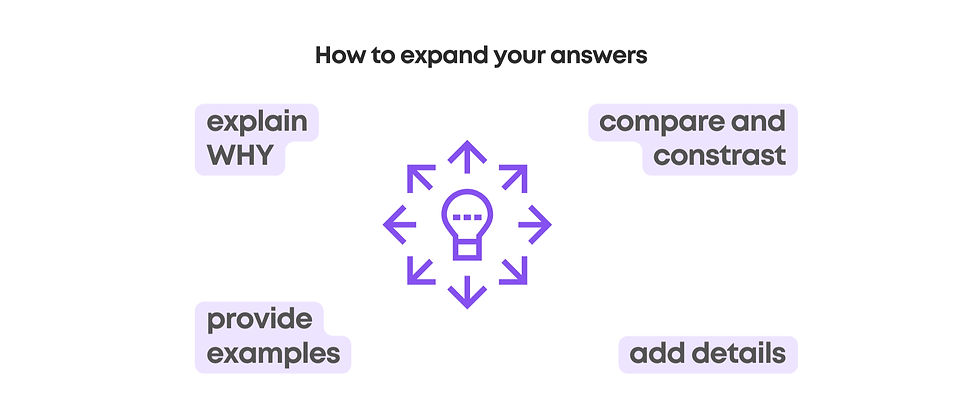
Expand your answer using one (or more) of the following techniques:
1. Give a Reason – Explain Why
Adding a reason shows fluency and coherence. Use linking words like because, since, or so.
Example:
Do you like getting up early?
→ “Not really, because I feel more productive in the evening. I prefer staying up late.”
2. Give an Example
Real-life examples help your answers sound natural and allow you to use specific vocabulary.
Example:
Do you like cooking?
→ “Yes, especially on weekends. Last Saturday, I made a homemade pizza with fresh ingredients.”
3. Compare and Contrast
Split your answer by time or place. This shows your ability to express more complex ideas.
Example:
Do you enjoy cooking?
→ “I didn’t like it in the past, but now I enjoy trying new recipes.”
What kind of clothes do you like to wear?
→ “At work, I dress formally, but at home, I prefer casual clothes.”
4. Add Specific Details
Mention emotions, frequency, duration, or answer WH-questions (who, where, when).
Example:
Do you exercise regularly?
→ “Yes, I go running three times a week. It keeps me energetic, and I usually run in the morning.”
Final Thoughts
To succeed in Part 1 of the IELTS Speaking test, remember these core ideas:
Be honest. Avoid inventing stories.
Adapt questions to fit your reality.
Use a clear structure: direct answer + expansion.
Expand using reasons, examples, comparisons, or extra details.
With practice, these techniques will become natural, and your answers will sound more fluent, detailed, and confident.
🎥 Want to see more examples and hear these techniques in action?
Watch the full video where we guide you through everything step-by-step—and don’t forget to download the free companion worksheet in the video description.


Comments