How to Plan Your IELTS Writing Task 2 Essay in 4 Steps
- Studdia Live

- May 19, 2025
- 4 min read
If you’re preparing for the IELTS exam, there’s one thing you cannot afford to skip—planning your essay. Many students ask whether they can just jump straight into writing. The answer is simple: ABSOLUTELY NOT.
Planning is part of the writing process. Even for something as small as writing an email, we naturally pause to think about what we want to say. So when it comes to IELTS Writing Task 2, a structured, academic essay, you can’t just start writing without a plan. The essay is where you present your arguments clearly and logically, and that begins with a few minutes of focused thinking.
In this post, we guide you through a 4-step planning process that helps reduce test anxiety and gives your writing more depth, clarity, and control—even under pressure.
Step 1: Understand the Task Properly
First, read the prompt carefully. Identify the topic and the specific issue—because you’re never writing about just a general theme. The IELTS prompt always narrows the focus.
Also, check the instructions to determine the essay type: opinion, discussion, problem-solution, advantages/disadvantages, or direct question. You need to know what’s expected before you begin.
If the task asks for your opinion, now is the time to decide. Do you agree, disagree, or partially agree? And remember—your personal opinion doesn’t matter. Nobody cares which side you choose, only how well you support it.
Interestingly, many Band 9 candidates often take a more nuanced or balanced view. This isn’t because it’s better—it’s because they’re more confident with the language and can explore topics from different angles. If you naturally feel that neither side is fully right or wrong, that’s okay. Be honest and go with what feels natural to you.
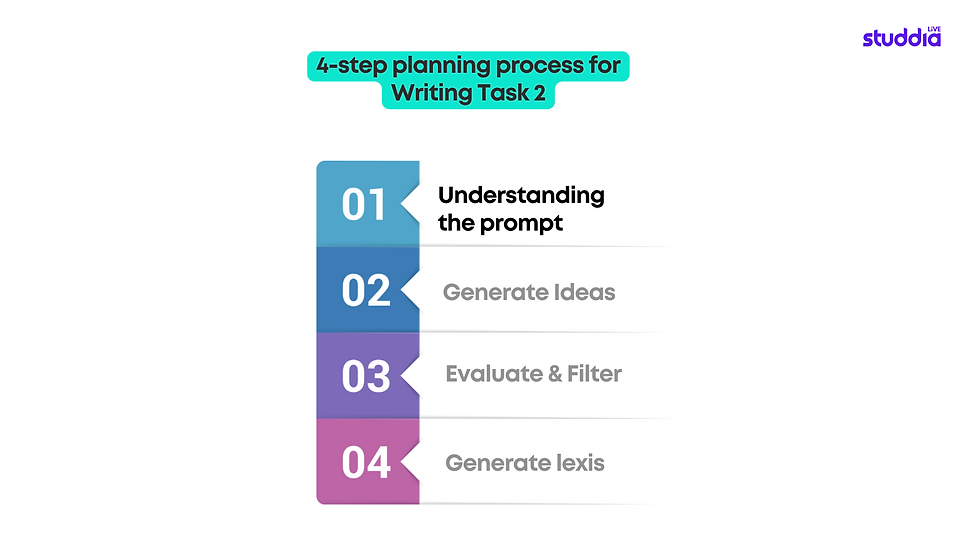
Step 2: Generate Ideas
Take a few minutes to sit, think, and let your ideas flow. But don’t keep them in your head—write everything down. Thoughts are fleeting, and your working memory is limited. The more you try to juggle mentally, the more overwhelmed you’ll feel.
Writing your ideas down helps you:
• Preserve useful thoughts
• See connections between ideas
• Spot strong arguments
• Avoid repeating yourself later
Use any method that works for you—mind maps, lists, tables, or messy notes. It doesn’t have to look pretty. This is your plan and no one else will see it.
At this point, generate two types of ideas:
• Main ideas – central points that directly answer the task
• Supporting ideas – explanations, examples, or evidence to develop each main point
One helpful technique is to imagine you’re explaining the question to a friend. Rephrase it in informal language or think of a personal example. This can make abstract topics more relatable and help your brain find useful content more easily.

Step 3: Evaluate and Filter
Once your ideas are on paper, it’s time to go back and critically assess them. For your main ideas, ask yourself:
• Does this idea directly answer the question?
• Can I write a full paragraph on it?
• Do I have examples or explanations to support it?
Do the same for supporting ideas—make sure they genuinely help clarify or strengthen your main points. If you find duplicates or ideas that are too vague, now is the time to cut them. Remember: more ideas don’t mean a better essay. A clear structure with two well-developed points is usually more effective than four half-baked ones.
Finally, decide on the order of your points. What will go into Body Paragraph 1 and what will follow in Body Paragraph 2?
Step 4: Prepare Your Vocabulary
Before you start writing, take a minute to think about the words and phrases you’ll need. Focus on key topic vocabulary and synonyms. IELTS asks for your lexical resource and range, and one way to demonstrate it is by avoiding repetition.
Think:
• Can I rephrase the key terms from the task?
• Do I know any relevant expressions?
• Are there alternative ways to say the same thing?
Jot these down quickly. That way, you won’t be searching for words mid-sentence when the clock is ticking. Your goal is to write with ease and flow—and that starts in the planning stage.

Final notes
You might be wondering: “Do I always have to follow these four steps in this exact order?” The truth is—not really. With practice, this process becomes more natural. You’ll find yourself generating an idea and instantly evaluating whether it’s useful. Or you may start with a supporting example and then realize what main idea it supports.
But the most important thing is that you have a plan. A routine that your brain can follow under pressure. This kind of structure doesn’t just lead to better essays—it also helps reduce stress, manage time, and improve overall performance.
🎥 Watch the full video lesson to see how each step works in practice. We walk you through the full process, with examples and deeper explanation to help you apply these ideas in your own writing.
And if you need extra support with your IELTS preparation, we’ve got you covered:
📘 Free e-book:
Start your journey with This Is Where You Begin:
✍️ Writing Feedback Service:
Get personalised feedback, estaimted band score, and expert guidance on your writing: https://www.studdia.live/services/ielts-writing-correction
🎓 IELTS Academy:
Our full course that brings serious results: https://www.studdia.live/studdia-ielts-academy
🗣️ Speaking Mock Exam:
Practice with a real examiner and get detailed feedback: https://www.studdia.live/services/ielts-speaking-mock-exam


Comments